

The museum with an unexpected star
I talked to the team at the National Gallery of Art, including 77-year-old curator Alison Luchs, about “rizzing up the internet with art history.”

Before we get into today’s newsletter, a quick ad! I partnered with the team at Slate to bring Link in Bio subscribers a critical discussion on the state of social right now. There’s no better person to have that conversation with than Carmen Vicente, Content and Social Lead at Slate and the creator behind some of my favorite videos on the algorithm. We’ll be talking about the good, the bad, and the ugly of working in social media—and answering some of your questions too! It’s happening on February 18th at 9 AM PT / 12 PM ET. You can RSVP here.

How the National Gallery of Art is “rizzing up the internet with art history”
“Chat, peep this bussin’ clay dish from the 16th century, made in the workshop of an Italian rizzler named Orazio Pompei.”
This is how a recent viral video from the National Gallery of Art opens. No, it’s not a Gen Z intern speaking. It’s Alison Luchs, a 77-year-old curator of early European sculpture. It is now the most-watched and most-engaged social post in the National Gallery’s history.
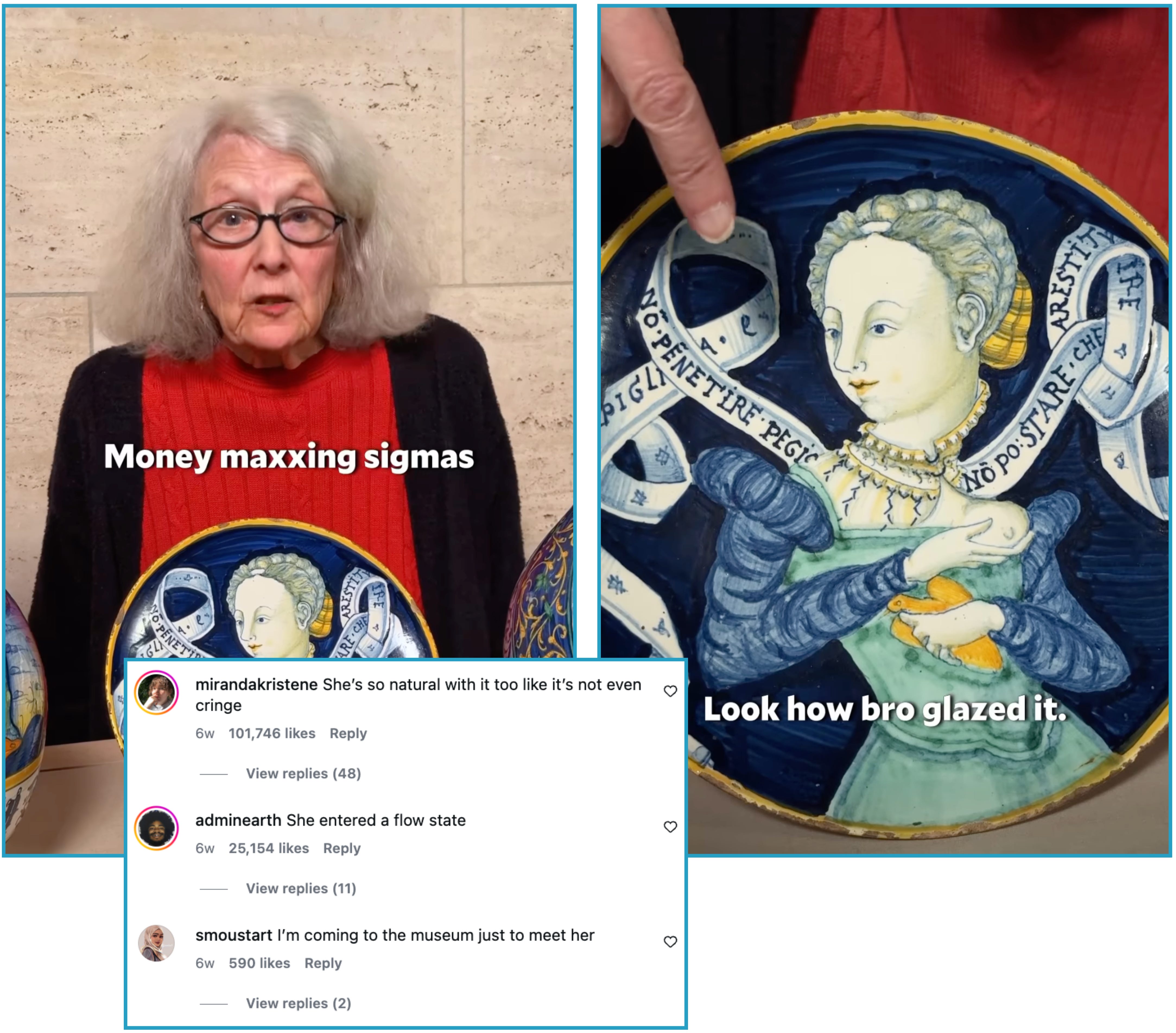
The idea for the video came from Sydni Myers, the Senior Social Media Manager at the museum. She told me over email, “I noticed a pattern among museums—mainly in the UK—where curators were speaking in Gen Z slang, language that originates in Black internet culture and AAVE.” Sydni wanted to see if she could push the trend in a more educational direction. She shared, “I was more interested in what would happen if we treated that language as a vehicle for art history, not just jokes. The idea was to focus on one overlooked object at a time and pair it with a curator who could deliver the language with sincerity.”
Sydni caught Alison, who she knew would be perfect for the role, as she was walking out of an all-staff meeting. Sydni asked if she’d be open to “rizzing up the internet with art history.” She remembers Alison pausing for a second and then saying, “If it helps bring attention to the sculptures, I’m in.” The rest is, well, history.
The juxtaposition of Alison, who commenters often call “grandma” and granny”, and the words coming out of her mouth creates a tension that immediately engages audiences. As Sydni put it, “People don’t expect to see a 77-year-old curator from a traditional art museum recite terminally online slang with monk-level seriousness.” That unexpected hook makes viewers want to stick around to learn about, say, maiolica plates and red purple stone urns.
When I asked Alison what she thought when Sydni first pitched the video, she said, “I was puzzled. I wondered who would want to watch a video of a very senior curator speaking Gen Z slang.” Turns out, a lot of people. Since the initial video’s success, the team has published another installment with more on the way. In total, the two videos have almost 9M views and a total watch time of over four years, according to the museum.
The process
Before scripting the first video, Alison took the social team on a tour of Italian Renaissance drug jars. (Yes, that kind.) They happened to pass by a specific maiolica plate which sparked a lot of conversation. (Watch the video, and you’ll understand why.) They decided to make that object the star of the Reel.
After the tour, the team set up what was essentially a writers’ room, with social media copywriter Mary King shepherding the script. “A group of millennials and Gen Z team members brainstorming how to make art history resonate online in the basement of an art museum,” as Sydni describes it.
Alison then memorized the script by treating it like a “linguistic challenge.” Alison speaks French, some Russian, and more languages.
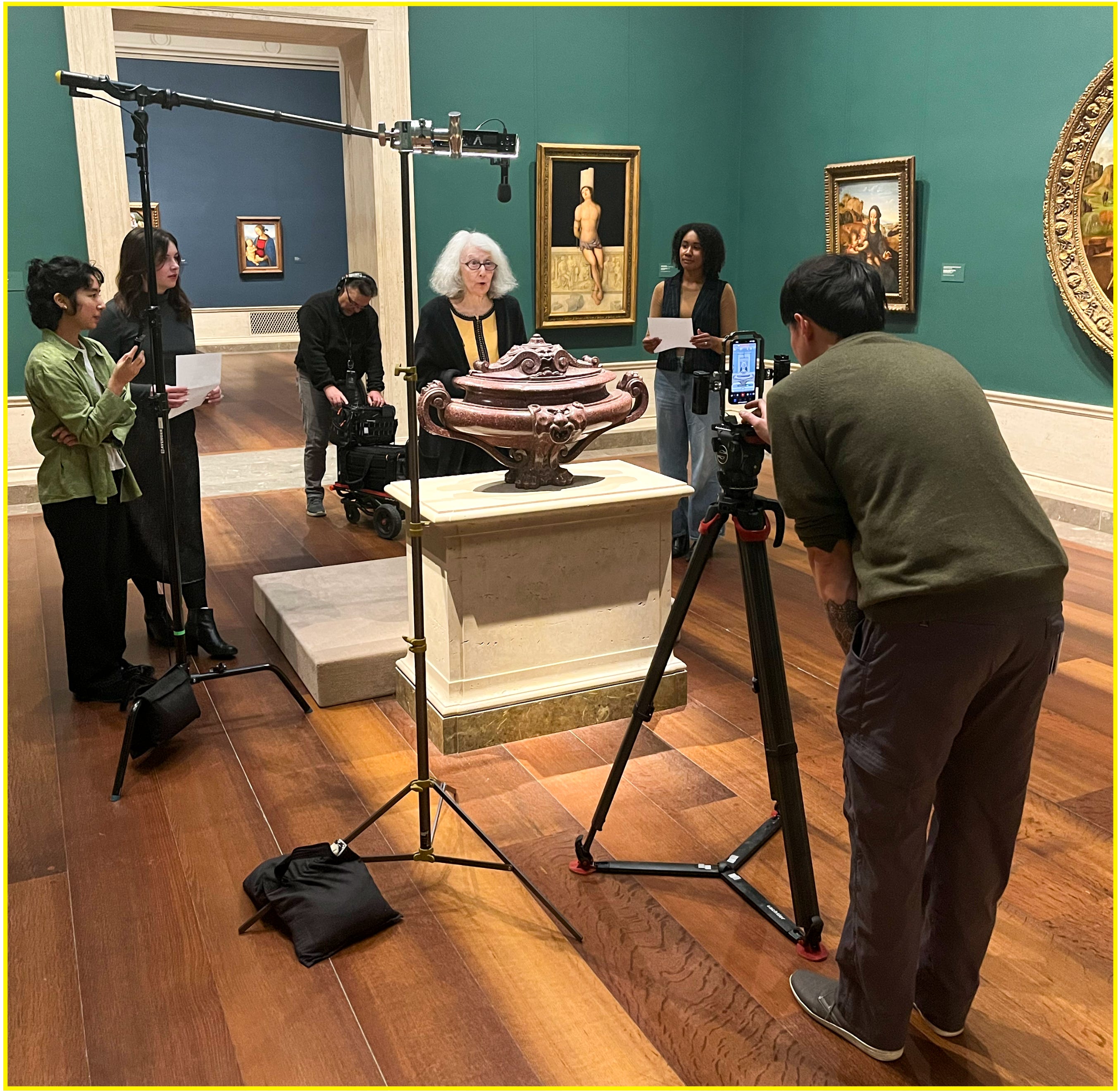
The videos are all shot and edited in-house. “Because we do quite a lot of media production across exhibitions and digital channels, we are lucky enough to have a production studio team,” Sydni tells me. One of those team members is Amelia Mylvaganam, who fans might recognize as the person who helps Alison get on set at the beginning of each video.
When I asked Alison if there’s a favorite phrase or term she’s learned from filming, she says, “How can you beat ‘The glow still slaps after 500 years!’”? That’s one of our main messages.”
Humor is a gateway
While most of the comments on the videos are positive, there are some that imply that art should be revered and not turned into a comedic sketch. When I ask Nick Sharp, Chief Digital Officer at the museum, what he thinks of this, he says, “Artists, authors, academics, and philosophers all joke, tease, and play in their everyday lives. The funniest person you know is probably also very smart. Art is made through discipline and seriousness, but also through mischief, curiosity, and humor. Those things are not in conflict. You can have fun in a serious way.”
The museum’s audience seems to understand this. Some of the top comments read “I’m in love with this series and love it when i can understand the significance of a piece!” and “I'm not even kidding, I learned a lot from this video.”
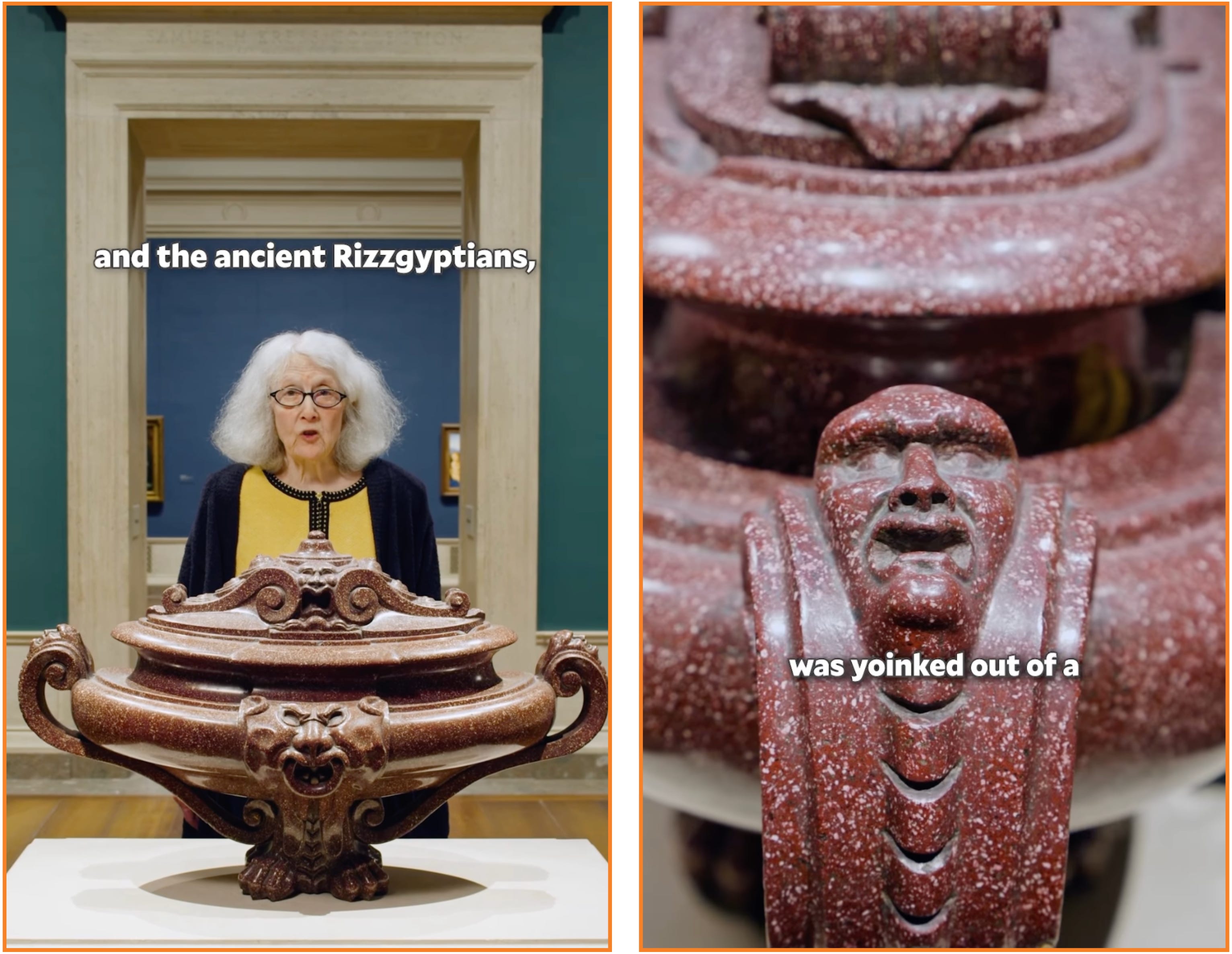
Alison also made clear that the artworks they are choosing are very intentional. She says, “In each case so far, we picked a work with playful content, that even the original audience was meant to have fun with. The approach could be disrespectful for a work of devotional art, for instance, or a painting of a tragic subject. But in the objects chosen for these videos, the joke is already there. It's not some trick we're playing on dead artists, it's something they wanted people to notice.”
For a lot of viewers, these videos might be their introduction to art altogether. That means something. As Nick put it, “Humor is a gateway. It makes people pause and pay attention, which is the first step toward looking and thinking. Take the maiolica plate: yes, the bird absolutely is giving phallic energy. And many people, myself included, did not even notice the exposed breast until Alison’s cheeky reference to it in the video. The humor, the surprise, makes you look, and then look again. That act of looking more closely is one of the core functions of an art museum.” Alison’s line of “titty out” is now one of the most referenced moments in the comments section.
The format is not only allowing the museum to highlight rare objects but also big organizational initiatives. At the end of the second video, Alison announced Open Call, inviting followers to submit a proposal for a 15- to 30-second social media video inspired by a work from their collection. Off camera, she had a little bit of a hot mic moment saying, “I hope this works.” A few days later, the museum started seeing comments like “it worked, queen,” along with hundreds of submissions. Sydni tells me they have over 400 entries, with a goal of reaching 500 by the end of February.
What’s next
This concept was never meant to be a series. The first video was simply a one-off idea. “I remember publishing the video while on an Amtrak train home at 7pm, seeing just a few supportive comments before I turned off my phone and took a nap—nothing more than usual. Then the next morning…I thought I signed into the wrong account!,” Sydni tells me.
Now, with two very successful videos under their belt, they are committed to making more. “For us, this series is part of a broader shift toward collaboration vs. broadcast. It’s one way we’re opening our doors wider and acknowledging that culture is co-authored,” Sydni shares. As I’ve talked about quite a bit in Link in Bio, the goal for many social teams now isn’t one viral video, but retention over multiple videos. Content that has a through line of familiarity and makes people comment “my show is on”. The National Gallery of Art seems to have found their show.
When I asked Alison if she was surprised by the success of the two videos she said, “I’m totally amazed. It never occurred to me that anything like this would happen. I figured we’d get a few likes and a few cringes and then it would disappear. But the comments have been really heartwarming, especially the ones from people who say the videos helped them get through a tough time, or the ones from people who say they now want to come to the National Gallery of Art and check out the artifacts, or that now their children might be more willing to come.”
So far, Alison has been recognized in public once. I have a feeling that number will have already gone up by the time I publish this.
What I’m scrolling
Speaking of accounts finding their shows, the Los Angeles Public Library is back with another reference desk video. 2.1M views and counting.
College athletic departments are wooing recruits with content studios. Good read from Front Office Sports. “Creative work was once largely an afterthought for collegiate athletic departments—maybe a lone social media coordinator tucked into a sports information office. But for many schools, multimedia has become a well-staffed strategic function resembling a Fortune 500 marketing team, complete with specialists including photographers, videographers, graphic designers, and social creators—plus suites of analytics dashboards and performance-tracking tools.”
The artist Lisett Ledón keeps popping up on my explore page. I love this post with Bad Bunny. A brand should partner with them on a campaign!
@kamalahq has relaunched as @headquarters_67 to “to give Democrats the digital boost they need to win in 2026 and beyond.” They are also hiring—giving us a clue into what the social content will look like. Lauren Kapp, who is one of the strategists behind the account, tweeted “If you like to cover politics, edit fancams, dunk or Republicans, or shit post… apply to be a Platforms Strategist or Video Editor on the HQ team!”
I’ve noticed a few brands gamify the horizontal video format. Starbucks did it here and Edinburgh Festival Fringe here.
I updated the Link in Bio Running List of Post Ideas. It now has over 150 formats to try. A resource I return over and over again!

“I really don’t look at it as promotion or marketing. I see myself as an artist expanding.” Timothée Chalamet on his press tour stunts but also me rationalizing my job.
WHAT’S YOUR PROCESS? is a new Instagram account I am excited about. So far they’ve only posted two Reels—one on the process of designing costumes for Heated Rivalry and another on the process of handling the best dogs in America—but they are both really fun to watch.
Claudia Sulewski’s video announcing that her brand Cyklar will be in Sephora is very sweet. It obviously helps to have tons of footage from your vlogging days, but I like how it turned into a moment for her audience to root for her. A top comment reads, “nooo. i’m genuinely crying. i’m so happy for you”
If the Berklee College of Music social director is reading this, we want more of these videos. The three videos of students singing “Golden” from KPop Demon Hunters in different styles have accumulated over 1.2M views.
If you enjoy free interviews like this one, you can upgrade to a paid Link in Bio subscription. You’ll get weekly strategy newsletters and quarterly trend reports, along with access to the Discord community.
It might even be an educational expense at your company! Here’s a template for you to use when asking.
And if you’re already a paid subscriber, ignore this and thank you!
The LA Public Library + National Gallery of Art are EVERYTHING right now 🖤
This was a wonderful breakdown of how all this came together. It’s easy to assume this was an off the cuff idea but reading all the thought behind this makes me love it even more!