

Treat LinkedIn like an ecosystem
Christina Le, Head of Marketing at Slate, shares her B2B playbook.

Today’s newsletter is sponsored by Slate, the content creation platform made for social teams.
Part of being a good social media professional is knowing your blind spots. B2B marketing is my blind spot. I have only ever worked for consumer-facing companies. I know how to show up on LinkedIn as a person (I have a Top Voice badge!) but brand strategy feels out of my wheelhouse. I know there’s a good amount of you who’d like me to cover the space more.
Today, I called in Christina Le, Head of Marketing at Slate, to share her B2B social playbook. She’s spent the past 10 years almost solely working in B2B social. What’s refreshing about her approach is that she views social media not as a distribution channel, but as one big ecosystem. It’s a framework I’ve been circling lately too. She told me, “When we approach our LinkedIn strategy, we don’t think ‘how do we grow the Slate page?’ We think, ‘how do we increase Slate’s surface area on LinkedIn?’” It’s an important distinction. I attempted to sketch out what that looks like in practice below.
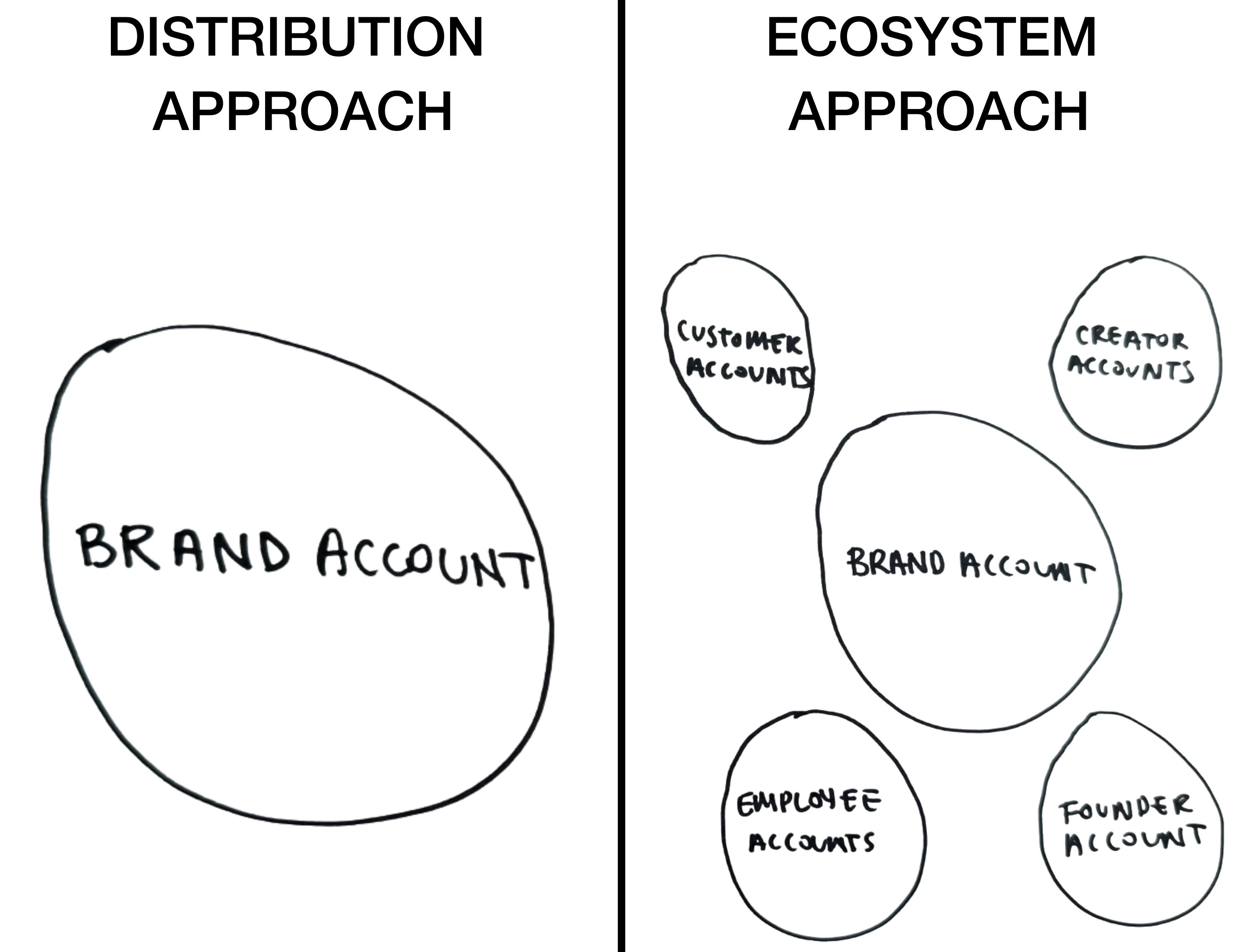
Christina’s job right now as Head of Marketing is to make sure the Slate story gets out there and that the product is positioned in a way that actually resonates with people who do social media for a living. (Slate is like your favorite video editing app…but for brands.) That story can come to life in so many ways beyond just the official brand account.
Below we talk about using people as a distribution engine, why message is more important than format, and the LinkedIn metric she loves to track.
Rachel Karten: If you had to sum up your philosophy when it comes to social media, what would it be?
Christina Le: Social isn’t just a distribution channel. It influences so many different avenues of the business like how the product is perceived, how we hire, investor confidence, sales conversations, customer support, literally everything. The brands that treat it like “just content” are limiting themselves. And if social is that central to the business, then the teams running it shouldn’t be treated like the meme department. They need real budget, real authority, and real tools.
At Slate, we build with that assumption and empathy. Our team has all worked in social before, so it makes all the world a difference. Social teams aren’t junior marketers anymore. They’re operators who drive real revenue and brand equity. They deserve software that respects their time and complexity.
RK: Your background is in B2B social. What do you think the biggest difference is between working in B2B social vs B2C social?
CL: The biggest difference is friction, I think. In B2C, the path is pretty clear: here’s the product, here’s the desire, here’s the purchase. You’re driving awareness and emotion toward something tangible.
But in B2B, you’re not just selling a product, you’re selling change inside an organization. That means you’re speaking to practitioners who feel the pain, but you also need decision-makers who control budget. And those aren’t always the same person.
So the content has to do two jobs at once. It has to resonate emotionally with the person doing the work, and it has to justify itself strategically to the person signing the contract. That’s why I fully believe that B2B social requires more positioning discipline. You can’t just be entertaining. You have to be useful. You have to build credibility, and be commercially aligned. And candidly, I think B2B social marketers could move into B2C more easily than the reverse.
In B2B, you’re constantly balancing. You’ve got the challenge of building a brand and then education, and then there’s revenue pressure. All of which sharpens you. It’s a different game. I mean, there’s much slower buying cycles. More stakeholders. But when it works, it compounds.
RK: Let’s focus our conversation on LinkedIn. I love the way Slate shows up there. What would you say LinkedIn’s superpower is?
CL: LinkedIn’s superpower is precision access. You can identify the exact companies in your Ideal Customer Profile and then see the actual humans who work there. Not a vague audience bucket, like “people interested in marketing.” Real names with real titles.
On other platforms, especially for B2B, you’re competing in a mixed feed. Your buyer, their employees, their cousin, and someone’s grandma are all scrolling the same algorithm. The signal gets diluted. On LinkedIn, I feel like the intent is different. People are there as professionals. They’re using their real identity. They’re thinking about work, growth, hiring, vendors, performance, you name it. You’re not interrupting their downtime outside of work. It’s also one of the few platforms where distribution is still relatively democratic. A strong idea from a practitioner can outrun a polished corporate page. And I feel like for B2B, that combination clear targeting and professional intent plus the organic reach that still works is very powerful. If you know who you’re trying to reach and you’re saying something worth listening to, LinkedIn gives you a straight line to them.
RK: Lately I’ve been thinking a lot about how brands should think about LinkedIn like an ecosystem. When I think about Slate’s presence, it’s not just the brand page. It’s employee posts, influencer posts, outbound comments, and more. How do you operationalize an approach like that?
CL: If you treat LinkedIn like just a brand page, you’re going to grow slowly. That’s just the unfortunate truth in 2026. For us, LinkedIn is layered. It’s our brand page, yes. But it’s also all those things you’ve listed and a few others, working together.
When we approach our LinkedIn strategy, we don’t think “how do we grow the Slate page?” We think, “how do we increase Slate’s surface area on LinkedIn?” That age old belief that “people follow people” is true. So we invest in personal brands internally. I wouldn’t call it a traditional advocacy-program because it’s more like, if you want to build your voice, we’ll support you. And because our team actually enjoys this, it compounds.
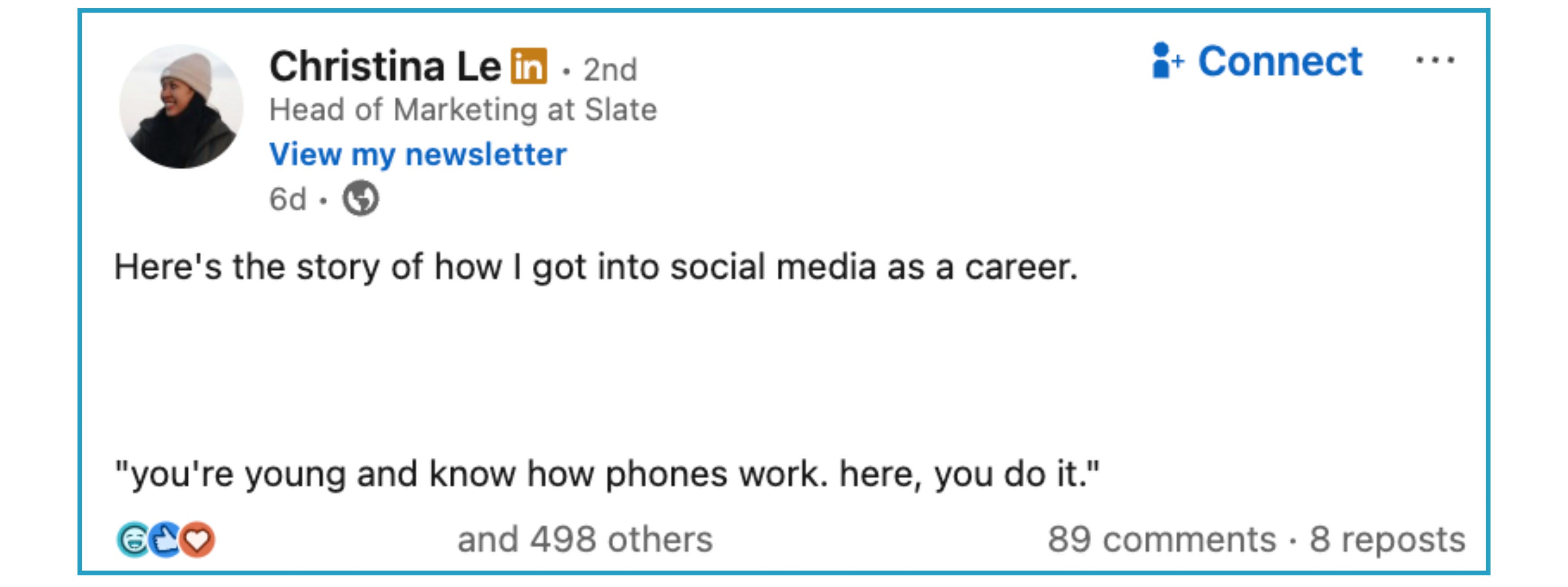
Operationally, we have swim lanes. Christina Pearo owns community and engagement, including how Slate shows up in comments and conversations. Carmen Vicente owns content output and consistency. I own partnerships and external distribution (creators, customers, collaborators, all that). Everyone knows their lane. Things overlap, but one person drives each stream.
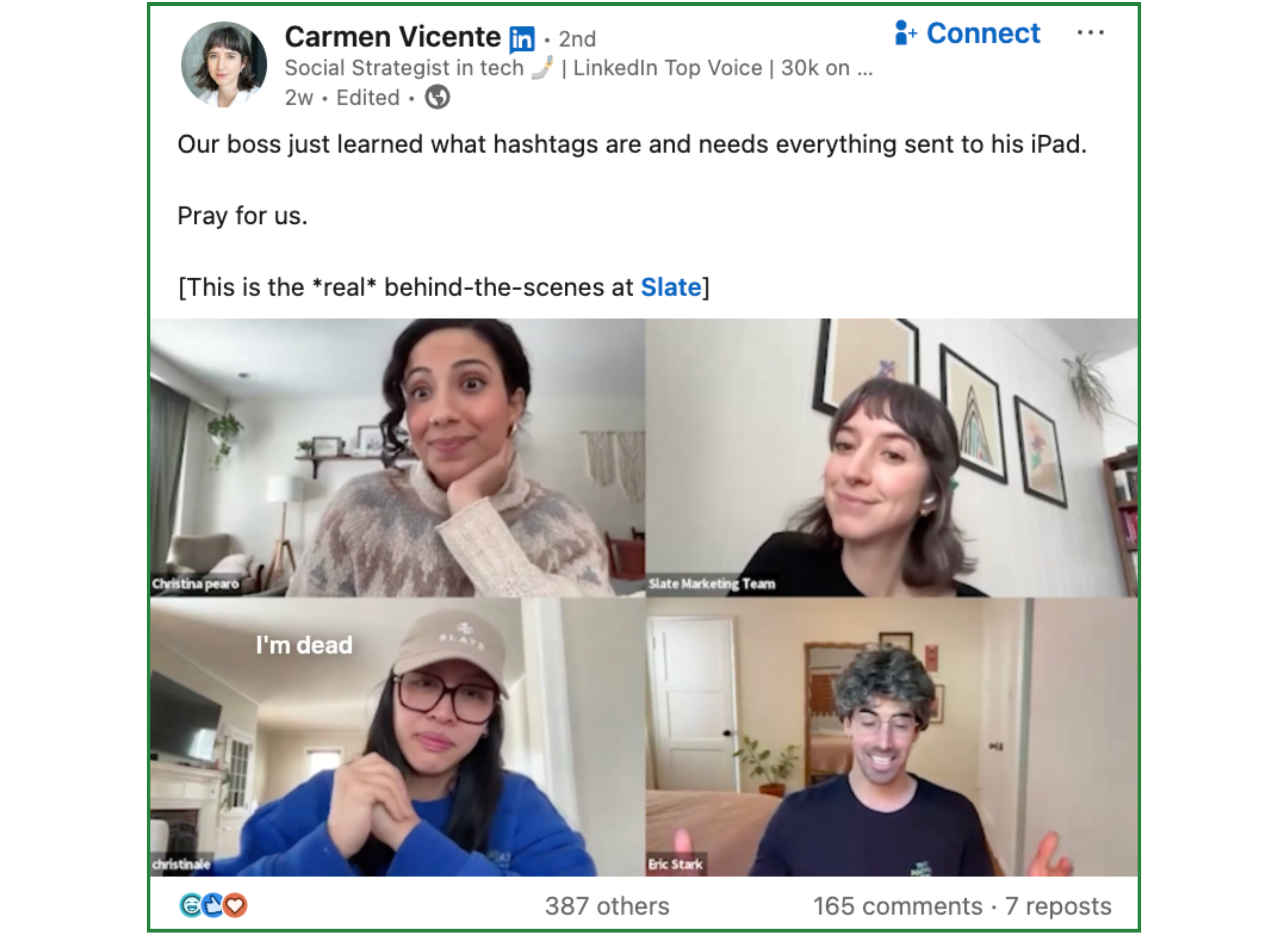
When we look at everything we do it might look scattered from the outside, but it’s intentional. We decide where reach should come from, then assign ownership. We review goals weekly. We iterate constantly. We’re also a fairly new team, so we’re still calibrating. Thankfully there is zero ego. If something needs help, we say it. Even our cofounder treats LinkedIn like a serious growth lever. That team alignment is what makes the ecosystem work.
RK: What types of post formats have you seen work particularly well on LinkedIn?
CL: Hmm. I actually think format matters less than clear messaging and direction. You can package the same idea as a meme, a video, a carousel, a text post and if the insight is sharp, it’ll land. If it’s weak, no format will save it.
I see people obsess over “carousels are hot right now” or “video gets reach.” That is all so secondary to me. The real question should be, whether this is something your audience actually thinks about? Like, does it feel earned? Format trends also come and go. I think brand operators should focus on saying something specific, and from experience. Good messaging travels.
RK: How do you track performance? Are there any unexpected metrics you like to look at?
CL: LinkedIn finally adding post-level follower growth and share tracking is huuuuuge. Impressions are fine. Engagement rate is fine. But shares tell you if something actually moved someone. If someone reposts your content, they’re attaching their reputation to it and what’s a better way to signal that your content is work than that?
I also care about qualitative signals like who is engaging? Are the right people in the comments? Are decision-makers responding? You can have a viral post that drives nothing meaningful. And I still believe in dark social. The DMs. The “saw your post” in sales calls. You can’t measure all of it, and going so deep with attribution will have your head spinning but you can feel when things work. Trust that it’ll show up.
RK: One tip you’d give a brand that’s struggling to break through on LinkedIn?
CL: Stop putting all your effort into the brand account! Use people as the distribution engine. Start internally. Who actually wants to show up? Support them properly. If that means giving them editing help, content prompts, or production support—do it. Don’t just tell them to “post more.” That’s not helpful.
Then layer in customer advocates. Then creators. Then partners.
There are more levers than paid ads, I promise. Oh, and don’t quit after three months. LinkedIn rewards consistency and voice. Commit.
RK: What do you love about working in social media?
CL: It never gets boring. NEVER. I’ve been doing this for over a decade and it changes so fast. The platforms are constantly changing. The algorithms is forever humbling us. You can’t coast. And I like that. If you hate repetition, social is a great place to be. And I love being connected and aware of what’s happening in the world. Social, even with all of this faults, is a great place to keep you connected.
If your social team wants to see Slate in action, you can request a demo here. The tool is made by social media managers for social media managers. Video and image editing, branding, and collaboration built for how social teams actually work.
Thanks for reading! See you next week!
Yessss! This is BFF-level marketing on LinkedIn: get close to real people, let them carry the story, and make it easy for the right audience to find you.
Thank you for this! Just starting to channel (pun intended) LinkedIn at work. Super helpful ✍🏼✨